Showing posts with label England. Show all posts

Tuesday, 18 February 2014

A Cock and Bull Story


Road into Stony Stratford
Once upon a time, in 18th and 19th century England, weary travellers would gather in the inns of Stony Stratford for a pint and to share the news of the day. At the time, Stony Stratford was an important stopover point for coaches travelling the Roman-built Watling Road between London and northern Britain. Coach travellers were the main source of news from remote parts of the country.
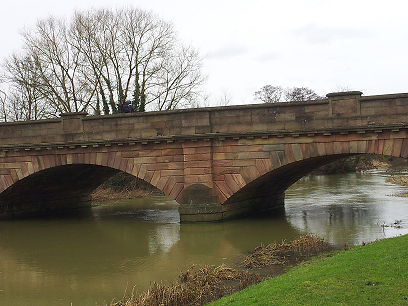
Bridge across the River Ouse


You know how it goes. A few pints in and tongues loosen, tall tales get taller. Storytellers compete to come up with the oddest, the strangest, the most outlandish stories. As the town’s web site tells it, the town’s two main coaching inns developed a rivalry as well, vying to be known as the best place to hear a good story. As it happened, these inns were named The Cock and The Bull. 
Bull Hotel, Stony Stratford


And this, the Stony Stratford Cock and Bull Society insists, is how the phrase ‘Cock and Bull story’ originated.

There are other stories claiming a different origin for the phrase 'Cock and Bull story' but this is Stony's story and they're sticking to it.


In honour of this proud story telling heritage, Stony Stratford holds an annual literary festival every January. The festival includes bardic trials that end with the selection of the town’s poet for the year. This year’s bard is Phil Chippendale.

But the story-telling and the drinking go on. This Friday and Saturday from noon to 11 p.m. both days, Stony Stratford is hosting the 11th Cock and Bull Real Beer Festival. You’ll find it at York House Centre on London Road (MK11 1JQ for your sat nav). Entry is free and the music is live, if you are interested in attending. 


 If you enjoy this blog, friend me on Facebook for further updates.

Monday, 17 February 2014

Spotted What?


While visiting the nearby town of Stony Stratford, I stopped in at the Cock Hotel (Now stop your giggling. Of course they mean rooster!) for a coffee. At least that's the animal on the picture outside.

                               The Cock Hotel in Stony Stratford                        Photo by Lynette Hill


Then I looked at their menu. It included a dish called Spotted Dick.  

 ???

Naturally I had to try it.


The staff helpfully explained that the dish is a steamed sponge cake, flavored with raisins and cinnamon and covered with a light vanilla sauce. I enjoyed every bite of the still warm pudding they produced.


                      Spotted Dick from Stony Stratford's Cock Hotel                                Photo by Lynette Hill


Traditional recipes include suet and currants. One variation, known as Spotted Dog, includes plums.


I recommend having one (the pudding, that is) with coffee for afternoon tea.


(For my American readers, pudding in British means dessert. As the Encyclopaedia Britannica explains, a British pudding can as easily be a cake as a custard. And by tea I mean the light meal generally served around 4 p.m., not the drink. Of course you knew that already.)


Food Fight:

The name has become embarrassing enough that in the early years of the 21st century a branch of the United Kingdom’s National Health Service attempted to rename the treat 'Spotted Richard.'  The supermarket chain Tesco's considered following suit. This raised the ire of the Pudding Club, determined defenders of traditional British desserts. Eventually the purists prevailed and the tasty, raisin-filled pudding kept its name.

But Why Call it Dick?

The short answer is that no one really knows. That is, of course, a completely unsatisfying answer.  Wikipedia offers the theory that the name evolved over time from pudding to puddink to dick. Given the variety and creativity of British accents I suppose that's possible.  I find their second theory, which blames the Germans, less likely.


How Old is It?

While similar recipes have been around since at least the 1600s, the Oxford English Dictionary says the earliest documented reference is a recipe for "Plum Bolster, or Spotted Dick", in Alexis Soyer's The modern Housewife or ménagère (1849). You’ll be pleased to know that the book is still in print and it’s even available on Kindle.


Make Your Own

The Food Network offers this modern recipe for making Spotted Dick. Just remember to prick four times before baking to let the fairies out. At least, I think it's a modern recipe.

Come back tomorrow and I'll tell you another 'Cock and Bull story.'

Thursday, 6 February 2014

Lost Roads of the Cattle Drovers


Do you enjoy solving mysteries? Here’s one that will take you out into the fresh air for a walk through lush British countryside in search of clues.

Photo by Joe Cornish for the National Trust

Before the development of modern transport, handlers moved their livestock on foot from pasture to town along set routes now known as drover roads. Livestock might include cattle, sheep, pigs or even geese.

Of course many of these roads are still in use. But many more have vanished back into the landscape.

Bruce Smith, a retiree living near Brackley in Northamptonshire, began seeking out these lost roads in 2005. He shared his passion for the subject at the Buckinghamshire Family History Society meeting at the Queensway Methodist Church Hall in Bletchley.

On his web site, localdroveroads.co.uk, Mr. Smith says, “The main purpose of country roads used to be for moving beasts, so most of the roads we drive along were made by or for drovers. Ones not tarmacked are now byways or bridleways, many have vanished altogether or been built upon. But there is still a vast network criss-crossing the British countryside.

“To come across an old road untouched by the 20th century is for me an utter joy: 200 years seem to slide off my shoulders.”

To find the old roads, there are a number of clues. First, look at the place names. According to Mr. Smith, drover’s roads tend to be named lane or way. Some are obvious, such as Drovers Arms for an inn or Bullock Way. Place names in England that refer to Wales are also good clues. Rother, the old English name for cattle, is also a giveaway. Names that include ox, cow or cat (for cattle) are almost always indicators of the drovers’ routes.

Photo from localdroveroads.co.uk
Inns that catered to drovers tended to cluster at the edge of town, to ensure that the cattle had plenty of pasture for grazing. Generally these inns had plenty of outbuildings or pasture nearby.
Drovers would also plant a cluster of three Scots Pines to indicate an obscure turn or a favoured inn or grazing patch.

Another way to find an old drove road is to pay attention whilst driving. If the new road turns while the old road continues straight on, often the old road was a drove road.  Wide verges, once needed for grazing, are also a sign the road once served the drovers and their cattle. Narrow fields running parallel to a road may indicate old grazing routes. 

Mr. Smith has identified a number of drover’s routes in Buckinghamshire. Here is a link to his web site with photos and further information about the old roads.

Thursday, 14 November 2013

University of the Air


Imagine this: you are walking down covered pathways on a university campus. It's a cold but sunny autumn day. Random sounds occur at unexpected places. A chime sounds and artificial wind blows out of hidden speakers. Disembodied voices make important-sounding statements.  It’s a bit like being a character in a movie, with your own soundtrack.

Ruth at the O.U.
To celebrate the fiftieth anniversary of its conception, the Open University commissioned four artists to develop works celebrating the university’s strongest fields. As my partner Ruth works at the Milton Keynes campus we took advantage of a sunny Sunday afternoon on 10 November 2013 to check out a work titled ‘On Air.’ The newspaper advertisement described it as ‘an immersive sound experience.’

???

At least, that was my initial reaction. I wasn’t sure what an ‘immersive sound experience’ was until we actually walked through it. It is the sort of thing you really need to experience to understand.
The creator of this experience is Caroline Devine, an artist who creates exclusively with sound. Among other things, she experiments with the way different tones resonate against a particular material. Tones in a place enclosed by brick walls will vibrate differently than an area surrounded by wood or metal. Of course the size and shape of the space makes a difference. We experience this every day, but how often do we actually listen to what is happening?
Jane Muir's 'For and Against'
To create the work, Caroline hid speakers along the paths of the campus art walk to play a repeating track of voices and sounds.
When we began the walk we found the artist sitting by herself near the start point of the installation, microphone in hand. Yes, she was recording, she told us. That’s what she does.
She was inspired, Caroline said, by the university’s original name:  the University of the Air.
Tom Harvey tree sculpture

The University of the Air was first proposed in 1963 as a correspondence college to improve educational opportunities throughout Britain. Today, according to the university’s web site, it provides long distance training to more than 240,000 students from the United Kingdom and Europe.
Personally I think they should have kept the original name.
To create the soundtrack itself, ‘I recorded the lecturers and plundered the (university) archives,’ Caroline told us. You can check out this interview with Caroline about the Milton Keynes installation on Youtube here.
The brochure of the event describes the work as ‘a 60 channel sound installation which transforms the air and animates the architectural and acoustic space around it.’
The brochure goes on to say that 'Caroline has explored the theme of OU research in design and technology, integrating an acoustic layer which allows fragments of thoughts, voices, knowledge, research and histories of The Open University to float on the air.’ 
I have to say we enjoyed the work, we enjoyed the walk, and we were definitely more aware of our surroundings as a result of having this experience.