Showing posts with label Milton Keynes. Show all posts

Tuesday, 18 February 2014

A Cock and Bull Story


Road into Stony Stratford
Once upon a time, in 18th and 19th century England, weary travellers would gather in the inns of Stony Stratford for a pint and to share the news of the day. At the time, Stony Stratford was an important stopover point for coaches travelling the Roman-built Watling Road between London and northern Britain. Coach travellers were the main source of news from remote parts of the country.
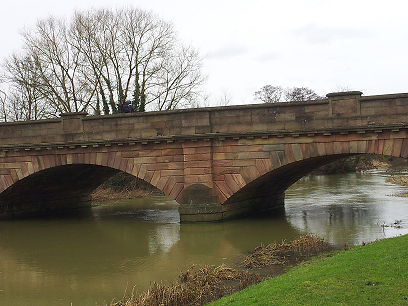
Bridge across the River Ouse


You know how it goes. A few pints in and tongues loosen, tall tales get taller. Storytellers compete to come up with the oddest, the strangest, the most outlandish stories. As the town’s web site tells it, the town’s two main coaching inns developed a rivalry as well, vying to be known as the best place to hear a good story. As it happened, these inns were named The Cock and The Bull. 
Bull Hotel, Stony Stratford


And this, the Stony Stratford Cock and Bull Society insists, is how the phrase ‘Cock and Bull story’ originated.

There are other stories claiming a different origin for the phrase 'Cock and Bull story' but this is Stony's story and they're sticking to it.


In honour of this proud story telling heritage, Stony Stratford holds an annual literary festival every January. The festival includes bardic trials that end with the selection of the town’s poet for the year. This year’s bard is Phil Chippendale.

But the story-telling and the drinking go on. This Friday and Saturday from noon to 11 p.m. both days, Stony Stratford is hosting the 11th Cock and Bull Real Beer Festival. You’ll find it at York House Centre on London Road (MK11 1JQ for your sat nav). Entry is free and the music is live, if you are interested in attending. 


 If you enjoy this blog, friend me on Facebook for further updates.

Tuesday, 3 December 2013

Willen Lake - A Place of Balance


Willen Lake North and Willen Village, 19 November 2013
 

          Willen Lake is young, just completed in 1974. At its most northerly point the lake nestles up against the ancient village also called Willen. Willen Village is known to be over 800 years old. Lake and village both take their name from the Anglo-Saxon word Willenge. Willenge means Willow tree. You will find Willows everywhere along the banks of the lake and overhanging the village paths.  
 
Willow Trees by Willen Lake

In the fading light of an autumn afternoon the waters of Willen Lake reflect back the sun's rays as if those waters have always been there. 
 Records first noted the village in the 12th century. Pasture and farm land made up the land currently underwater. The current church, still in use, was built in 1680. Construction of the lake began in 1972. Mother Nature brought about the lake’s actual birth a bit prematurely with heavy rains early in 1974.

Rain at Willen
The engineers who conceived it meant the lake to be a place of balance (definition of a balancing lake), and I think they succeeded. Of course, practical dreamers, the engineers' goal was to avoid an increase in flooding. The lake catches rain water that cannot be absorbed by urban concrete and slowly releases it into the River Ouzel. But the lake also balances the needs of nature and the local human population in other ways as well.
Running around Willen Lake
The western bank of Willen Lake, north and south, is full of things humans like to do. The eastern bank is bare of anything but grass and trees and the walking paths that circle the entire lake. The lake's total circumference, for those of you who wish to run, cycle, walk or chase your dog around the entire body of water, is said to be 3.13 miles or 5.04 kilometres.

      Willen Lake South is a place especially designed for human fun. Here you can go peddle-boating, sailing or kayaking. On its shores you can challenge yourself on a ropes course that includes a thousand-foot sheer drop called Goliath. There are tennis courts, a crazy golf, ice cream vans and a more conventional children’s playground. In the northeast corner of the southern lake you will find a large cable-tow facility for water-skiing. 
Water skier at Willen Lake South cable tow facility - photo by Lynette Hill

         Willen Lake North has been left to nature. It is quiet, a place for thinking, bird-watching and fishing. On the west bank you will find the first Zen Buddhist Peace Pagoda built in the western world, a Native American medicine wheel, even an outdoor labyrinth to walk in contemplative meditation. In other words, here is a space for your own thoughts. Here is a place you can use to seek your own balance.

Labyrinth beside Willen Lake North - Photo by Lynette Hill


Thursday, 14 November 2013

University of the Air


Imagine this: you are walking down covered pathways on a university campus. It's a cold but sunny autumn day. Random sounds occur at unexpected places. A chime sounds and artificial wind blows out of hidden speakers. Disembodied voices make important-sounding statements.  It’s a bit like being a character in a movie, with your own soundtrack.

Ruth at the O.U.
To celebrate the fiftieth anniversary of its conception, the Open University commissioned four artists to develop works celebrating the university’s strongest fields. As my partner Ruth works at the Milton Keynes campus we took advantage of a sunny Sunday afternoon on 10 November 2013 to check out a work titled ‘On Air.’ The newspaper advertisement described it as ‘an immersive sound experience.’

???

At least, that was my initial reaction. I wasn’t sure what an ‘immersive sound experience’ was until we actually walked through it. It is the sort of thing you really need to experience to understand.
The creator of this experience is Caroline Devine, an artist who creates exclusively with sound. Among other things, she experiments with the way different tones resonate against a particular material. Tones in a place enclosed by brick walls will vibrate differently than an area surrounded by wood or metal. Of course the size and shape of the space makes a difference. We experience this every day, but how often do we actually listen to what is happening?
Jane Muir's 'For and Against'
To create the work, Caroline hid speakers along the paths of the campus art walk to play a repeating track of voices and sounds.
When we began the walk we found the artist sitting by herself near the start point of the installation, microphone in hand. Yes, she was recording, she told us. That’s what she does.
She was inspired, Caroline said, by the university’s original name:  the University of the Air.
Tom Harvey tree sculpture

The University of the Air was first proposed in 1963 as a correspondence college to improve educational opportunities throughout Britain. Today, according to the university’s web site, it provides long distance training to more than 240,000 students from the United Kingdom and Europe.
Personally I think they should have kept the original name.
To create the soundtrack itself, ‘I recorded the lecturers and plundered the (university) archives,’ Caroline told us. You can check out this interview with Caroline about the Milton Keynes installation on Youtube here.
The brochure of the event describes the work as ‘a 60 channel sound installation which transforms the air and animates the architectural and acoustic space around it.’
The brochure goes on to say that 'Caroline has explored the theme of OU research in design and technology, integrating an acoustic layer which allows fragments of thoughts, voices, knowledge, research and histories of The Open University to float on the air.’ 
I have to say we enjoyed the work, we enjoyed the walk, and we were definitely more aware of our surroundings as a result of having this experience.